
DIY guide
How to Remove Oil Stains from Concrete and Driveways
How to remove oil stains from concrete comes down to speed and chemistry. A fresh drip on a driveway usually lifts completely if you soak it up quickly and follow with a concrete degreaser. An old stain that has sat for years needs a poultice to draw oil back out of the pores, and even then it may only fade. This guide covers both, plus which household remedies actually help, from the people behind our Melbourne pressure washing service.
Soak up fresh oil straight away, work in a concrete degreaser, scrub and rinse with a bucket. Use a poultice for old stains, and never hose oil into the street.
Before anything else
How do you remove oil stains from concrete quickly?
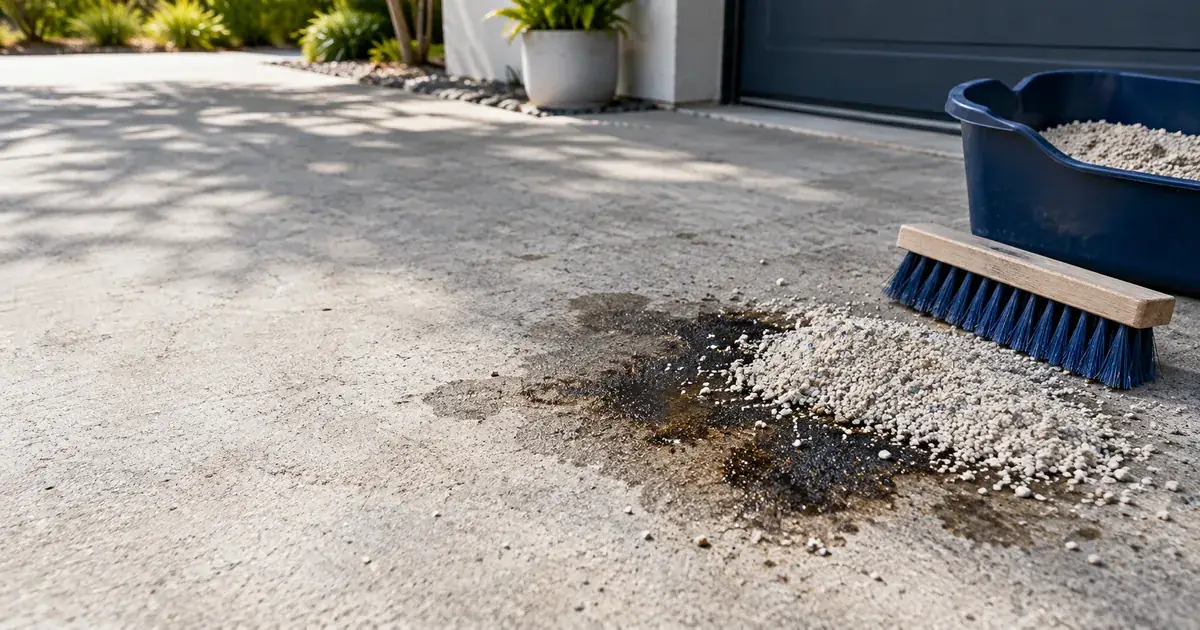
To remove oil stains from concrete quickly, act while the oil is still wet: cover it with cat litter, sawdust or sand, press it in with your shoe, leave it for a few hours and sweep it up. Then scrub in a concrete degreaser, let it work for fifteen to thirty minutes, and rinse with a bucket of warm water.
Timing matters more than any product. Concrete is porous, so oil starts creeping into it the moment it lands. Within a day or two, a drip that could have been blotted up has worked its way below the surface, and every week after that it goes a little deeper. A fresh spill is a ten-minute job; the same spill ignored for a year is a weekend project that may not fully succeed.
It also helps to know what you are dealing with. Engine oil, gearbox oil and power steering fluid behave similarly and respond to degreaser. Brake fluid can soften paint and some sealers, so rinse it thoroughly. Diesel and petrol evaporate quickly but leave a residue; ventilate the area and keep any flame well away while cleaning them up.
Kit list
What do you need to get oil off a driveway?
You need something absorbent such as cat litter, a concrete degreaser from a hardware store, a stiff nylon brush, a bucket, gloves and eye protection. For old stains, add a poultice powder or a stain-removal paste made for concrete, plus plastic sheet and tape to cover it while it works.
- Clay cat litter or sawdustSoaks up the wet oil before it goes deeper.
- Concrete degreaserAlkaline or enzyme-based; follow the dilution on the label.
- Stiff nylon brushWorks the product into the pores; avoid wire on coloured concrete.
- Bucket and warm waterFor rinsing without sending oil down the street.
- Poultice powder and plasticFor stains older than a few months.
- Gloves and glassesDegreasers are caustic enough to burn skin and eyes.
Step by step
How do you clean an oil stain off concrete, step by step?
Absorb what you can, sweep up the litter, wet the concrete lightly, apply degreaser and scrub it into the stain, let it dwell, scrub again, then rinse with warm water from a bucket and let it dry. Judge the result dry, and repeat once more if the stain has lightened but not gone.
- Soak up the loose oil. Cover the stain with cat litter, grind it in with your shoe and leave it for a few hours, or overnight for a big spill.
- Sweep it up and bag it. Oily litter goes in the bin, not the garden, and certainly not into the drain.
- Dampen the area. A little water helps the degreaser spread and work into the surface rather than soak straight in.
- Apply the degreaser. Pour it over the stain and a little beyond the edge, at the strength the label gives for heavy soiling.
- Scrub and wait. Work it in with the nylon brush, then leave it for fifteen to thirty minutes without letting it dry.
- Scrub again and rinse. Give it a second scrub, then rinse with warm water from a bucket, pushing the water onto soil rather than the gutter.
- Check it dry. Wet concrete hides the mark. Wait until it is fully dry before deciding whether to repeat or move on to a poultice.
Old stains
How do you shift an oil stain that has been there for years?
An old oil stain needs a poultice: a paste of absorbent powder and solvent spread over the stain, covered with plastic and left to dry for a day or two so it draws oil up out of the concrete. Scrape it off, rinse, and repeat if it keeps lightening. Expect a faded shadow rather than perfect concrete.
- MixBlend the powder with the solvent recommended on the pack to a thick peanut-butter paste.
- SpreadCover the stain about a centimetre thick, going past its edges.
- CoverTape plastic over it with a few pinholes so it dries slowly.
- LiftAfter 24 to 48 hours, scrape it off, bin it, rinse and check dry.
The reason old stains are stubborn is depth. After months of hot days and car tyres, oil has spread down and sideways through the concrete, so anything applied to the surface only reaches the top layer. A poultice works because, as it dries, it pulls liquid upwards like blotting paper. Each round brings a little more out, which is why two or three rounds on a very old stain are normal.
Household remedies
Do cola, baking soda and other home remedies work on oil stains?
Some help a little on fresh oil, but none match a proper concrete degreaser. Cat litter and dishwashing liquid are useful first steps, baking soda gives mild scrubbing power, and cola, WD-40 and bleach are mostly disappointments. Oven cleaner can work but is harsh, and petrol or thinners are dangerous.
| Remedy | What it does | Verdict |
|---|---|---|
| Cat litter or sawdust | Absorbs wet oil before it soaks in | Always worth it first |
| Dishwashing liquid | Breaks down light, fresh oil with scrubbing | Fine for small drips |
| Baking soda paste | Mild abrasive and absorbent | Helps a little |
| Cola | Weak acid; sticky residue left behind | Mostly a myth |
| WD-40 and similar sprays | Loosens oil but adds its own film | Moves the stain around |
| Bleach | Does not dissolve oil; can blotch colour | Skip it |
| Oven cleaner | Caustic; lifts some stains | Works, but harsh |
| Concrete degreaser | Made to emulsify oil in concrete | The right tool |
Mistakes to avoid
What makes an oil stain worse?
Hosing a fresh spill spreads it wider and sends oil to the drain. Solvents like petrol and thinners are a fire risk and push oil deeper. Acid etches the concrete around the stain, and a narrow pressure washer tip carves a pale ring that is more noticeable than the original mark.
- Hosing it down. Water floats oil across a bigger area and carries it to the street drain.
- Using petrol or thinners. A serious fire risk, and they thin the oil so it soaks deeper.
- Pouring acid on it. Acid does little to oil but etches the cement paste around it.
- Blasting with a narrow tip. It leaves a clean ring and a dark centre, which looks worse.
- Letting degreaser dry on. Dried product leaves a pale halo; keep it damp while it works.
- Ignoring the leak. A car still dripping will stain the same spot again within weeks.
The drain point matters. EPA Victoria's stormwater advice specifically lists car fluids and oil among pollutants to keep out of street drains, because those drains flow untreated to creeks and Port Phillip Bay. Soaking up and binning oil is always better than washing it away.
Different driveways
Does the method change on aggregate, pavers or coloured concrete?
The steps stay the same, but the care changes. Exposed aggregate tolerates degreaser well but loose stones can come out if scrubbed hard at the edges. Concrete pavers absorb oil like concrete, while oil between them soaks into the jointing sand. Coloured and stencilled concrete should only get products tested on a hidden patch first.
On pavers, the joints are often the hidden problem. Oil runs into the sand between them, and the stain keeps reappearing along the edges however clean the paver face looks. The simplest fix is to scrape out the oily sand, clean the pavers, and re-sand the joints once dry. Natural stone pavers, especially pale sandstone and limestone, are more absorbent than concrete; treat oil on them straight away and avoid strong alkaline products, which can discolour some stone.
Coloured concrete usually gets its colour from a surface coat or a tinted sealer. Strong degreasers and scrubbing can lift that colour along with the oil, leaving a pale patch. Test first, use the mildest product that works, and consider a tinted reseal of the whole area if the colour has already faded unevenly.
Prevention
How do you stop oil stains coming back?
Fix the leak, put a drip tray or garage mat under any car that weeps oil, and keep a bag of cat litter handy for spills. A sealed driveway is the long-term answer: oil sits on top of the sealer instead of soaking in, so a quick wipe and a degreaser clean most spills.
Drip trays are cheap and effective, particularly for older cars, trailers and ride-on mowers that live in one spot. A rubber garage mat does the same job and is easier to clean. If the driveway is already stained and you plan to seal it, clean the stains first; sealer laid over oil will not bond properly and can trap the stain underneath permanently.
Beyond DIY
When should oil stain removal be left to a professional?
Call a professional when several stains cover a large area, when two rounds of degreaser and a poultice have not helped, or when the driveway is coloured, stencilled or sealed and you do not want to risk the finish. Hot water pressure cleaning with commercial degreasers lifts far more oil than cold water and a brush.
Our oil stain removal service uses heat, degreaser and poultices, and tells you honestly how much will lift before you book.
Oil stain questions