
Concrete, aggregate and paved driveways
Driveway Pressure Cleaning
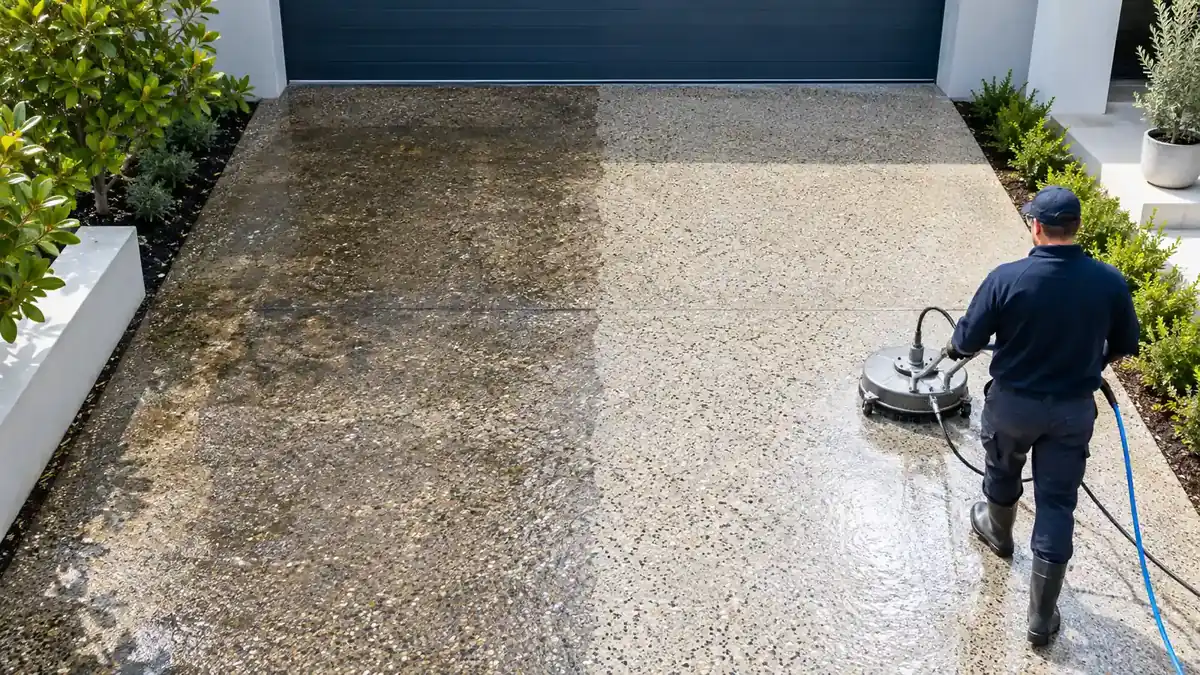
Driveway cleaning for Melbourne homes, done with a rotary surface cleaner so plain, coloured and exposed aggregate concrete dries to one even colour with no wand stripes. Oil drips, tyre marks, moss and black mould are treated before the main clean, and the edges, joints and garage apron are finished by hand. It is the job we are asked for most as part of our pressure washing across Melbourne.
- Area
- 35 to 50 m²
- Time on site
- 2 to 3 hours
- Water
- Your outside tap
- Guide price
- $180 to $350
What you get
What does driveway pressure cleaning in Melbourne include?
Driveway pressure cleaning in Melbourne covers the whole slab from the garage door to the footpath: stains and growth pre-treated, the open area cleaned with a surface cleaner, edges and joints detailed, and the loosened grime rinsed away. Side paths, the porch and the front step can be done on the same day.
The people who book a driveway clean tend to fall into a few groups. Owners getting a house ready for sale want the front of the property to photograph well, because the driveway fills a big part of the listing shot. Tenants finishing a lease want the oil patch under their car gone before the final inspection. Others simply notice that the concrete has gone dark and patchy over five or ten years and want it back to one colour, often before sealing it.
Melbourne driveways vary more than people expect. Growth-area estates around Point Cook, Craigieburn, Clyde and Officer are lined with wide exposed aggregate driveways. Inner suburbs have narrow plain concrete strips beside older brick homes, some with tyre tracks worn into them. Coloured and stencilled concrete from the 1990s and 2000s is common in the middle ring, and pavers turn up everywhere. Each one is cleaned a little differently, which is covered further down this page.
- The whole slab
Edge to edge, including the strip under where the car usually sits.
- Edges and joints
Expansion joints, fence lines and the gap along the garden edge.
- Garage apron
The grimy band along the door seal and the step into the garage.
- Stain pre-treatment
Degreaser on oil and tyre marks, mould treatment on shaded strips.
- Front crossover
The section between the footpath and the road, if you want it done too.
- Final rinse and check
Grime and grit rinsed off, then the slab checked again once it has dried.
Method
How do we pressure clean a driveway?
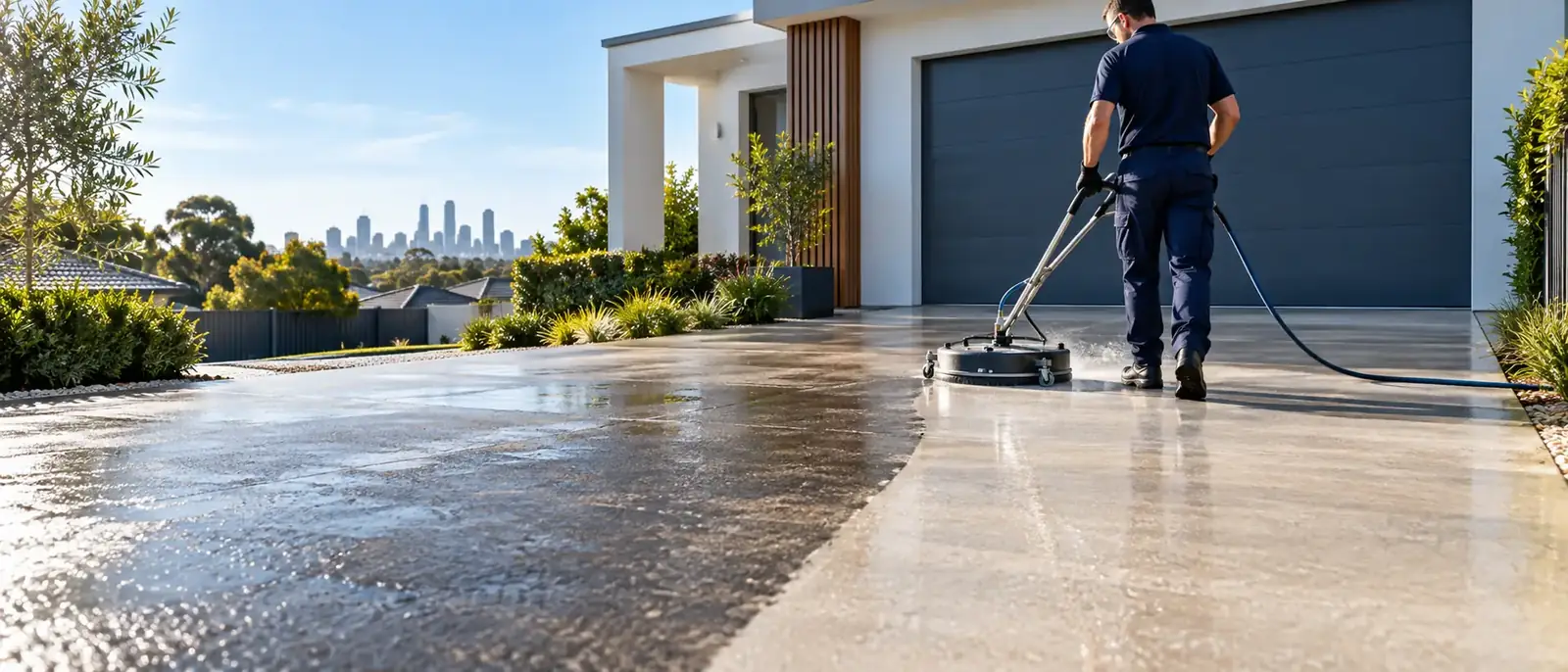
We clear and sweep the driveway, test a hidden patch, pre-treat stains and growth, then run a rotary surface cleaner over the slab in overlapping passes. Edges and joints are finished with a fan tip, and a final low-pressure rinse carries the loosened grime away from the house.
- Clear and sweep
Cars, bins and pot plants moved; leaves and grit swept so they cannot jam the cleaner.
- Test a patch
Pressure and pace checked somewhere discreet, such as the spot where the wheelie bin lives.
- Pre-treat
Degreaser goes on oil, a mould treatment goes on the shaded strip, and both are given time.
- Surface clean
Steady overlapping passes; the hood also stops spray hitting walls, windows and cars.
- Edges and joints
A fan tip along the door seal, the fence line, expansion joints and any steps.
- Rinse and recheck
Loosened grime rinsed off, then a second look once dry, when faint marks show up.
A standard double driveway takes two to three hours from arrival to pack-up. It is usually dry enough to drive on within an hour or two on a warm day and a little longer in winter.
Marks and stains
What can be removed from a driveway, and what cannot?
Mould, algae, moss, general grime, fresh oil, tyre rubber, leaf stains and most rust marks come off a driveway with the right treatment. Oil that has soaked in for years, paint, acid etching and failed sealer are harder, and some of those will only fade, which we tell you from the photo.
| Mark | Usually caused by | What we use | Realistic result |
|---|---|---|---|
| Black mould and green algae | Shade and damp through winter | Mould treatment, then surface cleaner | Fully removed; slower to return if treated |
| Tyre marks | Hot tyres turning on the slab | Degreaser and a hot rinse | Usually gone |
| Fresh oil drips | A leaking sump or gearbox | Degreaser, dwell time, hot water | Usually gone |
| Old soaked-in oil | Years of drips in one spot | Repeat degreaser passes, poultice if needed | Lighter; a shadow often stays |
| Rust spots | Bore water, fertiliser, metal furniture | Rust remover suited to concrete | Mostly faded or gone |
| Leaf and tannin stains | Wet leaves left sitting over winter | Oxygen-based cleaner and rinse | Usually gone |
| White efflorescence | Salts drawn up by moisture | Efflorescence cleaner on dry concrete | Removed, may return on damp slabs |
| Paint splashes | Renovations and fence painting | Stripper for the paint type, then rinse | Water-based lifts; oil-based varies |
Two things decide how well a stain lifts: how long it has been there and how porous the concrete is. A fresh drip on a sealed driveway sits near the surface and comes out easily. The same drip left for five years on unsealed concrete has worked its way down into the pores, and no amount of pressure will pull it all back out. Pushing harder at that point only etches the surface around it, which leaves a pale ring that looks worse than the stain did.
If you want to have a go yourself first, our guide on cleaning a concrete driveway yourself, including mould, algae and rust walks through what works with hardware store products, a stiff broom and a bucket.
Protecting the surface
How is your driveway protected during the clean?
Protection starts with matching pressure and pace to your type of driveway, then extends to everything around it: garden edges, the garage door seal, parked cars, weep holes and the stormwater pit at the kerb. Wash water carrying oil or cleaning products is blocked and collected, not hosed into the gutter.
Plain concrete
Around 3,000 to 4,000 PSI- How we clean it
- Surface cleaner at a normal pace, with a turbo tip saved for stubborn spots along the edges.
- The risk
- A narrow tip held still carves a permanent swirl. Slabs poured in the last month are still curing and should be left alone.
- Afterwards
- Ready to seal once fully dry, usually a day or two later in mild weather.
Exposed aggregate
Around 2,500 to 3,000 PSI- How we clean it
- Surface cleaner raised slightly and run slower, with mould treated along shaded strips first.
- The risk
- Loose stones near edges and cracks, and old sealer turning white or flaking as the clean lifts it.
- Afterwards
- Patchy or peeling sealer usually needs stripping and redoing, which is quoted as a separate job.
Coloured or stencilled
Around 2,000 to 3,000 PSI- How we clean it
- Lower pressure and a gentler pace, always starting with a test patch in a hidden corner.
- The risk
- The colour often sits in a surface coat or sealer, and high pressure can strip it into light patches.
- Afterwards
- Sun-faded colour can look uneven once clean; a tinted reseal brings it back to one tone.
Paved driveway
Around 1,500 to 2,500 PSI- How we clean it
- Surface cleaner on a low setting, with weeds and moss in the joints treated beforehand.
- The risk
- Jointing sand blasted out, leaving pavers free to shift and weeds free to return.
- Afterwards
- Joints are re-sanded once the pavers dry, and a sealer helps hold that sand in place.
Around the driveway, garden beds and lawn edges are wet down before any product goes on and rinsed again at the end. The base of the garage door and its rubber seal get a gentle rinse rather than a direct blast, and cars are moved or covered. Weep holes and vents in brick walls beside the driveway are never sprayed straight on.
You do not need to be home, but the driveway must be empty. Leave cars on the street or at work, keep the garage door shut, and let us know about any irrigation lines or lights set into the slab edges so they are cleaned around rather than over.
Wash water is the part most operators ignore. Melbourne's street drains carry whatever enters them straight to local creeks and the bay, and EPA Victoria says only rain should go down them. It has fined a building company over a driveway clean where the run-off reached the Werribee River, which is set out in its March 2025 media release. When degreaser or heavy oil is involved, we cover the kerb pit and collect the water instead.
A clean driveway stays that way for longer once it is sealed, because oil and mould have nowhere to soak in. If that is your next step, read about sealing concrete driveways and pavers.
Prices
How much does driveway cleaning cost in Melbourne?
Most Melbourne driveways cost between $180 and $450 to pressure clean, depending on size, surface and staining. A single driveway sits near the bottom of that range, a standard double runs about $180 to $350, and long or battle-axe driveways work out at roughly $3 to $6 for each square metre.
Single driveway
$180 to $250
About 20 to 30 m². Usually at or close to our minimum charge.
Double driveway
$180 to $350
About 35 to 50 m². Exposed aggregate and heavy mould sit at the upper end.
Long or battle-axe
$3 to $6 per m²
60 m² and over, including shared driveways behind front units.
- Oil stain treatmentPer stained area, depending on age$60 to $150
- Heavy mould treatmentLight growth is included in the clean$40 to $80
- Paver re-sandingAfter the joints are cleaned outQuoted per area
- Side paths and porchAdded to the same visit$3 to $6 per m²
Guide figures for 2026, including GST. The things that move a driveway price most are the surface type, how much oil and growth there is, and access: a steep driveway, a tight side gate or no outside tap near the front all add time. Our full price list for every surface covers paths, pavers, decks and house washing as well.
A much cheaper driveway quote usually means something has been left out. The common gaps are no pre-treatment, so mould is back by next winter; a hand wand instead of a surface cleaner, so the slab dries striped; and no plan for oily run-off. It is worth asking any operator what they use on oil, how they avoid stripes and where the wash water will go. Clear answers to those three questions tell you more than the price does.
Send a photo
How do you send a photo of your driveway for a quote?
Stand at the street and take one photo of the whole driveway, then take a close up of the worst stain and one of any shaded, mossy strip. Send those through with the suburb, and you get back our planned method, a written price and an honest idea of the finish.
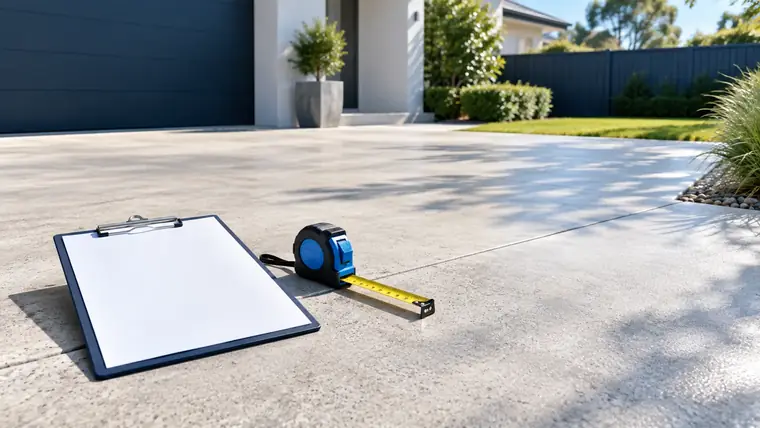
From the footpath. The whole driveway in one frame shows its size and shape.
The worst mark. Oil, rust or tyre marks up close, so we can judge how deep they go.
Rough measurements. Length and width in steps or metres is plenty.
Questions
What else do people ask about driveway cleaning?
How much does it cost to pressure clean a driveway?
Will pressure cleaning damage my driveway?
How long does a driveway clean take?
Oil patch, mossy strip or just tired concrete?Send two photos of the driveway and get a written price back.
Send photos