
Car parks, docks, shopfronts and strata
Commercial and Industrial Pressure Cleaning
Commercial pressure cleaning for Melbourne car parks, loading docks, service areas, shopfronts, footpaths and strata common property, booked around your trading hours. Hot water deals with grease and oil, surface cleaners keep large slabs even, and wash water is contained and collected rather than sent to the stormwater drain. It is the site-scale end of our Melbourne pressure washing services, with the paperwork managers and body corporates ask for.
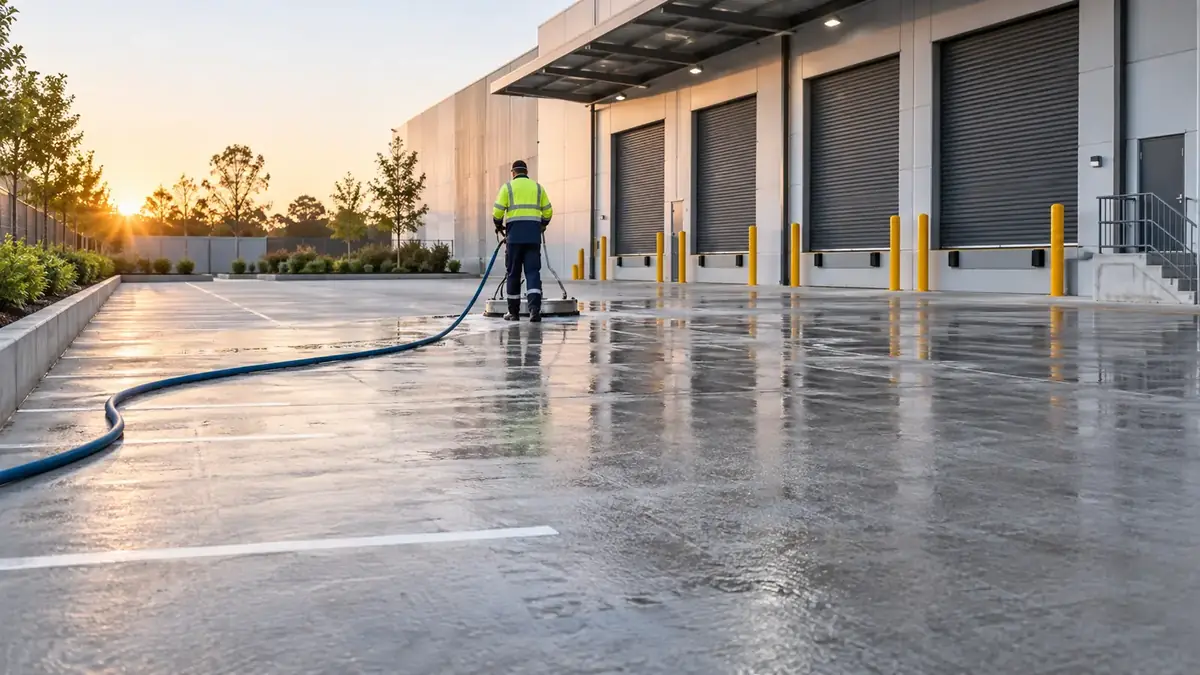
- Site
- Retail car park
- Shift
- 10 pm to 5 am
- Water
- Hot, recovered
- Pricing
- Per site, written
Sites we clean
What does commercial pressure cleaning in Melbourne cover?
Commercial pressure cleaning in Melbourne covers any hard surface a business, landlord or owners corporation is responsible for: car parks and basements, loading docks and hardstand, shopfronts and footpaths, service station forecourts, strata entries and bin rooms, and hospitality courtyards. Most sites are cleaned outside trading hours.
Car parks and basements
Oil drips under every bay, tyre marks at ramps and turns, and grime that builds in corners where sweepers do not reach.
Often every 6 to 12 months
Loading docks and hardstand
Diesel, hydraulic fluid, pallet debris and forklift tyre marks, often with safety line marking that must stay readable.
Often quarterly for busy docks
Shopfronts and footpaths
Chewing gum, drink spills, bird droppings and grime at the entry, where first impressions are made every morning.
Monthly to quarterly
Service station forecourts
Fuel spills and oily film around bowsers and wash bays, where grease must be broken down with heat, not spread.
Scheduled around fuel deliveries
Strata common property
Entry paths, driveways, bin rooms and courtyards shared by owners, often cleaned before an AGM or a building sale.
Six-monthly or yearly
Hospitality courtyards and bins
Food fats, spilled drinks and bin area residue that attract pests and leave smells in warm weather.
Monthly in summer
Commercial pressure washing differs from residential work in scale and in the rules around it. The surfaces are bigger and dirtier, the grease is heavier, and the site usually cannot close. There may be a site induction, a safe work method statement to lodge, pedestrians and cars moving nearby, and a property manager who needs photos to show the owners. The cleaning method is familiar; the planning around it is what makes a commercial job run smoothly.
Industrial pressure cleaning of factory floors, hardstand and workshop aprons follows the same approach with more emphasis on degreasing and waste handling. Bayside retail strips from St Kilda down through Brighton to Mentone add salt, sand and seagull droppings to the usual grime, and tend to need shopfront cleaning more often than inland centres.
How a site night runs
How is a commercial site cleaned around trading hours?
A commercial site is cleaned in the hours it is empty or quiet, usually overnight or early on a weekend. Areas are coned off in sections so the rest stays usable, degreaser and hot water go on oily zones first, the open slab is cleaned with a surface cleaner, and wash water is vacuumed up as the work moves along.
An example overnight shift in a retail car park
Cones and signs out, drains covered, recovery equipment staged.
Degreaser on bays, ramps and bin areas, left to work.
Hot water through the surface cleaner, one section at a time.
Water collected, area swept, photos taken, site reopened.
Grease is the main difference between commercial and home work. Cold water tends to push oily grime around a car park rather than lifting it, so we use hot water units for bays, ramps, docks and bin areas. Heat thins the grease, the degreaser breaks it down, and a surface cleaner removes it evenly without leaving the stripes that are so obvious on a large slab under car park lighting.
Line marking, tactile indicators and anti-slip strips are cleaned around with care. High pressure held close can lift paint and loosen adhesive products, so those areas get a lower setting and a wider tip. We also record anything worn or damaged before we start, which helps managers plan repainting and avoids arguments about what was there already.
Wash water and the law
What happens to the wash water on a commercial site?
At a business premises, wash water carrying oil, grease or cleaning products is contained with drain covers and bunding, collected with a recovery vacuum, and disposed of lawfully. It does not go down the stormwater drain, because in Victoria that is treated as pollution and the site operator carries the risk.
Under Victoria's environment laws, every business has a general environmental duty to reduce the risk of harm from its waste and pollution so far as reasonably practicable, and that includes the water from cleaning its car park. Letting oily run-off drain to the street puts the business and its contractor on the wrong side of that duty.
The sewer is not an automatic alternative either. Water corporations treat wastewater from business activities as trade waste; Yarra Valley Water explains that discharging trade waste to sewer needs an agreement or consent. We plan disposal for each site before the job, either through the site's own approved arrangements or by taking the collected water away.

Paperwork for managers
Which documents come with a commercial quote?
A commercial quote comes with the documents facility and strata managers usually need to approve a contractor: a public liability certificate of currency, a safe work method statement for the task, safety data sheets for the products used, and a plan for traffic, pedestrians and wash water. Site inductions are completed before work starts.
- Certificate of currency
Public liability insurance, current for the job dates.
- Safe work method statement
The task, its hazards and the controls, specific to the site.
- Safety data sheets
For every degreaser and cleaning product brought on site.
- Traffic and pedestrian plan
Where cones, signs and closed sections will be, and when.
- Wash water plan
How run-off is contained, collected and disposed of.
- Completion photos
Before and after images for the owner, board or tenant.
For regular contracts, the same documents are kept current and resent when they change, so a strata manager or centre manager is not chasing paperwork before each visit. If your site uses a contractor management platform, we can upload documents there as well.
Owners corporations have their own rhythm. Committees often want a quote well before a meeting, a clean timed just before an annual general meeting or a building sale, and notices to residents about which areas will be closed and when. We supply a short notice you can forward to residents, and schedule work so every lot keeps access to its car space or entry throughout.
People and surfaces
How are staff, customers and surfaces protected?
People are protected by working when the site is quiet, closing sections with cones and signs, and never spraying near anyone walking past. Surfaces are protected by setting pressure for each material, keeping jets off line marking and joint sealants, and testing on a small area first on decorative paving and coloured concrete.
Wet surfaces are slippery, so areas stay closed until they have been swept and are safe to walk on. Shopfront work is timed so the footpath is dry before the first customers arrive. Where the building has glass entries or signage close to the ground, the spray is kept low and angled away.
Expansion joints and sealants in car park slabs deserve particular care. A narrow jet can cut out joint sealant, which lets water into the slab and the level below. Car park decks with membranes or coatings are cleaned at the pressure the coating manufacturer allows, and we ask for that information when quoting if the building has it.
Noise is the other thing managers ask about. Pressure washers and hot water units are not silent, so on sites near homes we start the noisiest work at a reasonable hour, keep machines at the far side of the site from bedrooms where possible, and follow any council or centre rules on hours. On busy retail strips, early morning shopfront cleaning is usually the best balance.
Prices
How is commercial pressure cleaning priced?
Commercial pressure cleaning is priced per site after photos or a walk-through, because area, grease, access, hours and water recovery change the cost far more than on a home. As a rough guide, large open slabs work out cheaper per square metre than homes, while greasy docks and bin areas cost more.
| Factor | Effect on price | Why |
|---|---|---|
| Total area | Lower rate per m² as area grows | Set-up is shared across more surface |
| Grease and oil | Higher | Degreaser, hot water and more passes |
| Water recovery | Higher where full recovery is needed | Extra equipment, time and disposal |
| After-hours work | Moderate | Night and weekend shifts |
| Regular schedule | Lower per visit | Surfaces stay easier to clean |
Residential rates for comparison are on our pressure cleaning prices page. For contracts, we can quote a single visit and a scheduled rate side by side so you can compare.
Site quote
What details help us price a commercial site?
Send the site address, the areas to clean with rough sizes or a site plan, photos of the worst areas, the hours the site can be closed, and any induction or document requirements. For larger sites we arrange a walk-through, and the quote comes back in writing with the paperwork attached.
Areas and sizes. A site plan, a satellite screenshot or rough measurements.
Worst areas. Photos of oily bays, docks, bin rooms or entries.
Access windows. When the site is empty, and any noise limits.
Requirements. Induction, contractor platform or document list.
For facility managers
What do facility and strata managers usually ask?
How much does commercial pressure cleaning cost?
Will cleaning damage line marking or coatings?
How long does a commercial clean take?
Oily car park, grimy dock or tired shopfront?Send the site details and receive a written quote with the paperwork.
Request a quote