
Render, weatherboard, cladding and brick
House Washing and Soft Washing
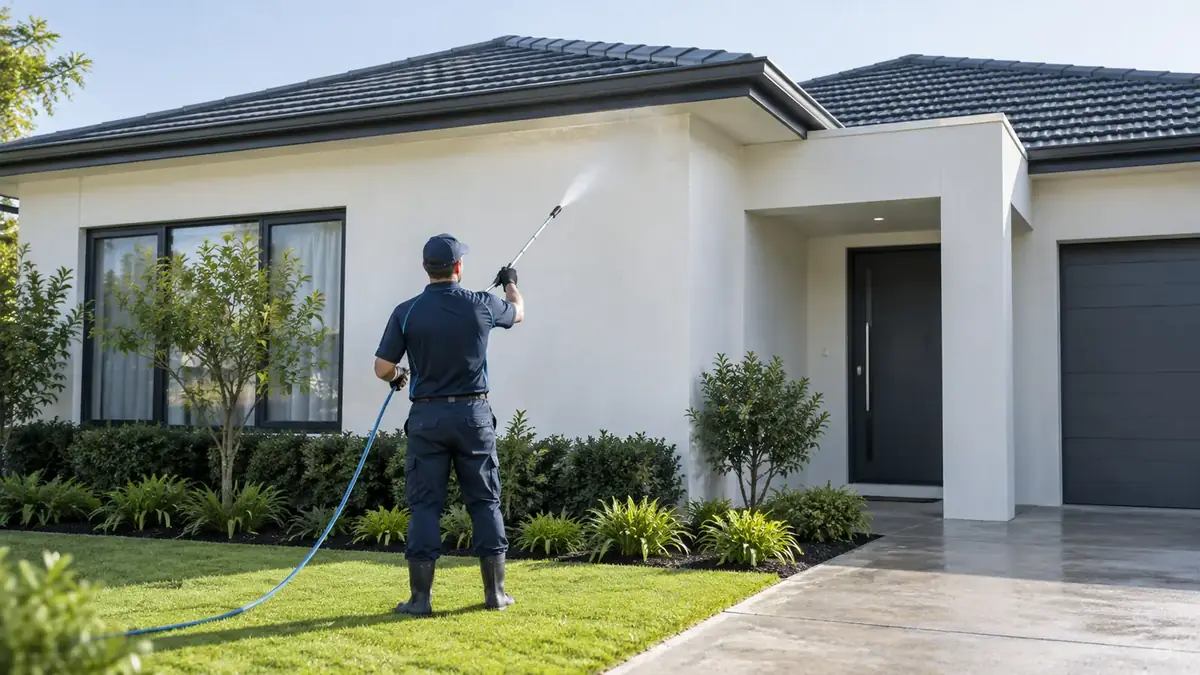
Soft washing is how we wash the outside of Melbourne homes: a mild cleaning solution applied at low pressure, left to break down dirt, mould and cobwebs, then rinsed off gently. Render, weatherboard, fibre cement, metal cladding and painted brick come up clean without the stripped paint, cracked render or forced-in water that high pressure can cause. It is the gentlest part of the work we do as a Melbourne pressure washing company, and everything is done from the ground.
- Home
- 3 bed, single storey
- Walls
- Render + eaves
- On site
- 3 to 5 hours
- Guide price
- $350 to $650
Why soft washing
What is house washing and soft washing in Melbourne?
House washing and soft washing in Melbourne means cleaning a home's exterior walls, eaves and trims with a low-pressure spray of cleaning solution rather than a high-pressure jet. The solution kills mould and loosens dirt; a gentle rinse removes it. It cleans as thoroughly as pressure washing without the damage a jet does to paint and render.
What a house wash covers
- External walls: render, weatherboard, fibre cement, metal and brick
- Eaves and soffits, including cobwebs and wasp nests' leftovers
- Fascias, gutter faces and downpipes from the outside
- Window frames, sills and security screens, rinsed
- Front porch, pillars and entry areas
What it does not cover
- Roof cleaning, which is a separate service with its own safety needs
- Clearing leaves out of gutters
- Detailed, streak-free window cleaning of the glass
- Solar panels on the roof
- Repainting, render repairs or sealing cracks
People book a house wash for different reasons. Some are getting ready to sell and want the front of the home to look cared for in photos and at inspections. Some are about to repaint and need the walls clean so the new paint bonds. Most simply notice that the south side has gone green, the eaves are full of webs and the render looks grubby, and want it back to the colour it was.
Melbourne's climate is behind a lot of it. Cool, damp winters let mould and algae grow on shaded walls, dust and pollen settle in spring, and homes near busy roads collect a grey film of traffic grime. Coastal homes on the peninsula and around the bay add salt spray to that list. None of these marks are permanent, and nearly all of them come off with the right solution and a gentle rinse.
The process
How is a house soft washed?
We start with a walk around to note cracks, flaking paint and open vents, soak the garden, close windows, then work side by side: solution on from the bottom up, a few minutes to work, and a low-pressure rinse from the top down. The shaded side is treated first because it needs the longest.
Order matters. Applying solution from the bottom up stops it running down dry wall in streaks that can leave marks; rinsing from the top down carries everything cleanly to the ground. Working one side at a time keeps the solution from drying on a warm wall, which is why a hot summer afternoon is not the time to wash the west side of a house.
Second-storey walls are reached from the ground. A soft-wash pump throws solution up to the upper walls and eaves, and extension wands handle the rinse, so nobody needs to climb onto the roof. Where a second storey sits over a steep slope or a pool, we talk through access before quoting.
A diluted chlorine-based solution, the same active ingredient as household bleach but far weaker, kills mould and algae.
A mild soap that helps the solution cling to walls and lift traffic grime and cobwebs.
Plain water at low pressure, plus plenty of extra water on the garden.
Example route for a north-facing block. Green dashes show garden beds soaked before any solution goes on. The route changes with orientation and access.
Wall by wall
How is each type of wall washed?
Every exterior finish is soft washed, but the strength of the solution, the dwell time and the rinse change with the material. Acrylic render and paint get the gentlest treatment, fibre cement and metal cladding a standard wash, and brick and stone a little more agitation where moss has taken hold.
| Wall finish | What builds up | How we adjust | Watch for |
|---|---|---|---|
| Acrylic render | Black mould spots, green algae, dirt streaks | Mild solution, longer dwell, very gentle rinse | Hairline cracks; soft, chalky coatings |
| Cement render, painted | Mould, chalking paint, cobwebs | Standard mix, soft brush on stubborn spots | Paint that rubs off on a finger |
| Timber weatherboard | Mildew under laps, flaking paint, grime | Rinse angled down the boards, never up under laps | Water forced behind boards |
| Fibre cement cladding | Algae, dust, traffic film | Standard soft wash and rinse | Sealed joints and trims |
| Colorbond and metal | Dust, salt, dull chalky film | Mild mix, quick rinse so nothing dries on | Scratches from brushes; stay soft |
| Face brick and stone | Moss, mould at the base, efflorescence | Treatment plus a light brush, low rinse | Weep holes and soft mortar |
Our guide on cleaning render and washing a house yourself walks through a smaller-scale version with a garden sprayer, if you want to try one wall first.
What comes off walls
What does a house wash remove?
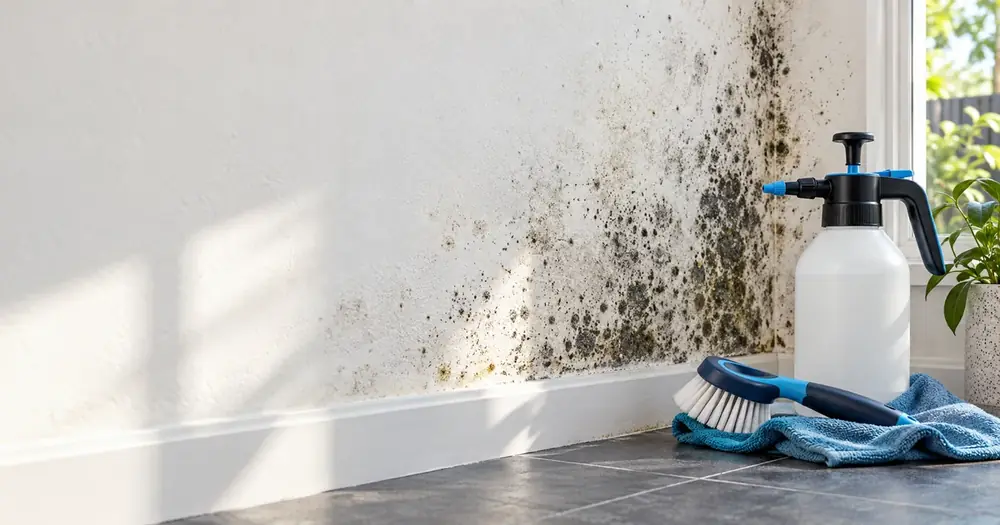
A house wash removes black mould spots, green algae, mildew, cobwebs, dust, pollen, bird droppings and the grey film that traffic leaves on walls. It does not remove faded or chalking paint, rust from old fixings, or stains soaked deep into unsealed render, although those often look better once the dirt around them is gone.
Black spots on render are the most common reason people call. They are mould colonies, and they sit in the texture of the render where a brush cannot reach. A soft wash solution kills them where they sit; they lighten during the rinse and keep fading over the following days as they break down. That is normal, and it is also why a house often looks even better a week after the wash than on the day.
Cobwebs and the dark marks spiders leave under eaves come away easily. Bird droppings on sills and ledges are softened by the solution and rinsed off. Faded, chalky paint is a different matter: if a wall leaves white powder on your hand, the paint itself is breaking down, and a wash will make it cleaner but not new. Repainting is the fix, and a clean wall is the right start for it.
Eaves deserve a word of their own. They are sheltered from rain, so dust, webs and spider droppings build up for years, and they are often the first thing visitors notice once the walls are clean. We wash eaves before the walls below them, so nothing drips onto a finished surface. Redbacks and white-tailed spiders like the corners of eaves and sheltered window ledges, so gloves stay on and hands stay out of dark corners.
Timing
Which season suits a house wash in Melbourne?
Autumn and spring are the best times to wash a house in Melbourne. Autumn clears summer dust and cobwebs before winter mould sets in, and spring removes that mould before the entertaining season. A house can be washed in any month, but midsummer work is done early in the day so the solution never dries on hot walls.
- Spring
Winter mould at its worst and pollen arriving. A good time to reset before summer.
- Summer
Walls dry fast, which helps, but work starts early to keep the solution off hot render.
- Autumn
The ideal lead-in to repainting, and it slows how fast mould returns over winter.
- Winter
Soft washing still works in the cold; walls just take longer to dry afterwards.
Two events decide the timing more than the season does. If you are selling, book the wash a week or two before the listing photos, so the house is clean for the shoot and any black mould spots have finished fading. If you are repainting, book it before the painter starts; most paint makers ask for walls free of mould, dust and chalking before a new coat goes on, and a professional wash saves the painter a day of preparation.
Home and garden care
How are gardens, windows and electrics protected during a house wash?
Gardens are soaked with water before and after the wash so plants take up clean water, not solution. Windows and doors are closed, vents and external power points are covered, and air conditioning units and the electrical switchboard are rinsed around rather than into. Cars, pets and pond water are kept well clear.
Plants are the thing most people worry about, and the answer is water, lots of it. Wet leaves and soil do not absorb a diluted solution the way dry ones do, and a thorough rinse at the end washes off any overspray. Delicate plants right against a wall, such as potted herbs or young seedlings, are moved or covered. Fish ponds are covered completely.
Rinse water from a house wash contains a small amount of cleaning solution, so it is directed onto lawn and garden rather than down the gutter. EPA Victoria's stormwater guidance lists detergents among the things that should never go into street drains, and on most sites the garden handles the small amount far better than a creek would.
Outside, we look for anything that should not get wet: open wall vents under the floor, external power points without covers, pool pump housings and the switchboard. They are covered with plastic or rinsed around by hand. Before starting we also check for loose render, cracked seals around windows and flaking paint, and photograph anything already damaged, so there are no surprises for either of us.
Prices
How much does a house wash cost in Melbourne?
A single-storey house wash in Melbourne usually costs $350 to $650, and a double-storey home $600 to $1,100, depending on size, wall type, mould and access. Adding the driveway, paths or fences to the same visit is cheaper than booking them separately, because set-up and travel happen once.
| Home | Guide price | What moves it |
|---|---|---|
| Unit or small single storey | $280 to $420 | Number of exposed walls |
| Single storey, 3 to 4 bedrooms | $350 to $650 | Render or cladding, mould, garden access |
| Double storey, 3 to 4 bedrooms | $600 to $1,100 | Upper walls, balconies, eaves height |
| Eaves and soffits only | From about $180 | Length of eaves, cobweb build-up |
| Add driveway or paths | Reduced rate | Size and staining |
Rates for the rest of the property, from driveways to decks, are on our pressure cleaning prices page. Many owners combine a house wash with the driveway before selling, which is also the best value.
The reduced rate for extra surfaces is real rather than a sales line. The biggest costs of a visit are travel, setting up hoses and equipment, and packing it all away again. Once that is done for the house, adding a driveway or path mostly costs the time spent cleaning it, so the saving is passed on in the quote.
House photos
What photos do we need to price a house wash?
A photo of each side of the house taken from the yard, plus a close up of the worst wall, is ideal. Let us know the number of storeys, what the walls are made of if you know, and anything awkward such as a steep side path, a pool fence or a tight gap to the boundary.
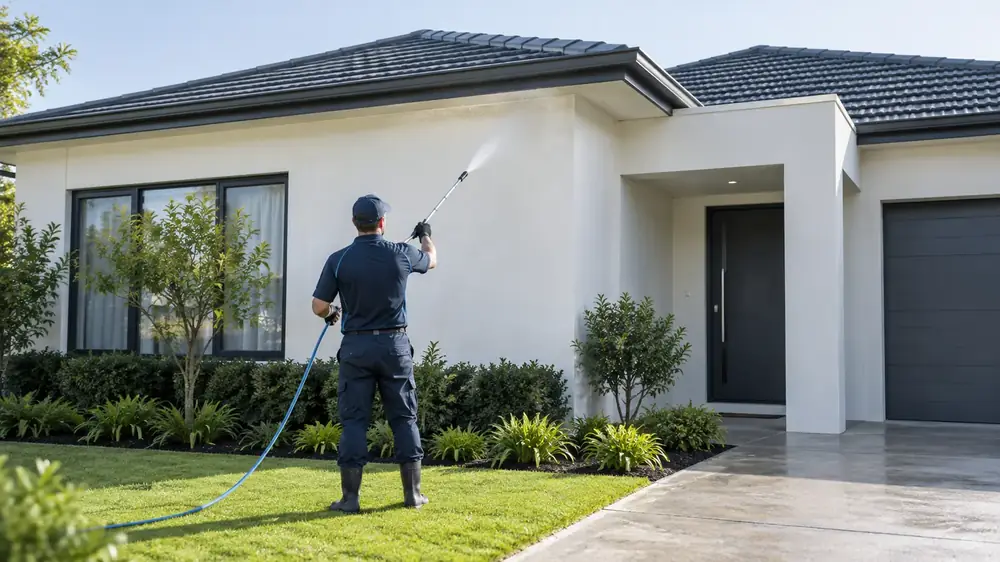
Each side. Front, back and both sides, standing back far enough to see the eaves.
The worst wall. Usually the shaded side; a close up shows how heavy the mould is.
Access. Side gates, slopes, pools and anything we need to work around.
House washing FAQ
What do people check before booking a house wash?
How much does it cost to wash a house?
Will soft washing damage paint, render or plants?
How long does a house wash take?
Green walls, grubby eaves or selling soon?Photograph each side of the house and we will price the wash.
Send photos