
Walls, fences, paths and new brickwork
Brick Cleaning
Brick cleaning for Melbourne walls, fences, letterbox piers and brick paths, plus the mortar and cement smears left on new brickwork after a build. We lift moss, mould, grime and white salt bloom with methods that keep the mortar joints intact, which matters most on pre-war homes built with soft lime mortar. It is one of the specialist services within our pressure washing work around Melbourne.
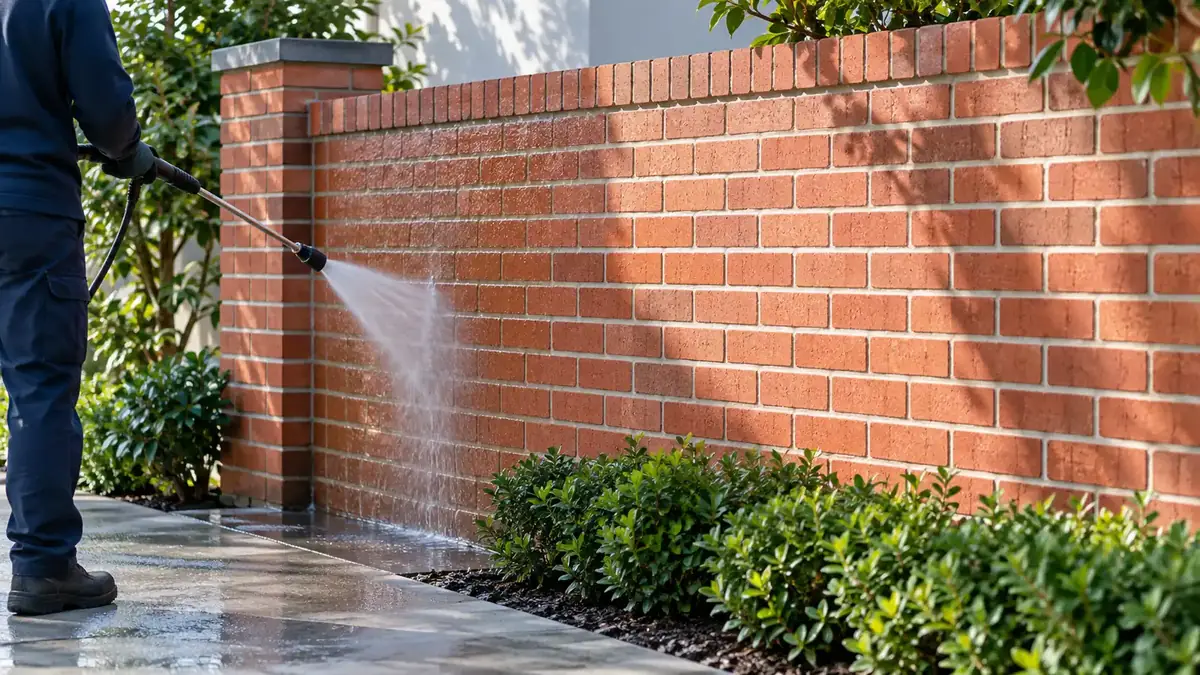
- Length
- 15 to 25 m
- Height
- Up to 1.8 m
- Method
- Treat + fan rinse
- Guide price
- $150 to $350
Three kinds of brick job
What does brick cleaning in Melbourne usually involve?
Brick cleaning in Melbourne usually means one of three jobs: bringing old walls and fences back from moss and grime, cleaning brick paths and paving, or a builder's clean of new brickwork to remove mortar and cement smears. Each uses different products and pressure, because the risks to the brick and mortar are different.
Walls, fences and piers
Green moss on the shaded face, black mould along the base, grime from traffic and old cobwebs under cappings. A mould treatment and a low, wide rinse do most of the work.
Low pressure, treatment first
Brick paths and paving
Clay pavers laid in herringbone or basket weave, often with moss in the joints and white salt bloom after rain. Handled much like other paving, with joints checked afterwards.
Surface cleaner, joints re-sanded
New brickwork
Mortar dags, cement film and smears left once the bricklayers finish. This is a chemical clean using a brick cleaning solution, never a blast with high pressure.
Wall saturated, cleaned top down
Melbourne has a lot of brick, and a lot of it is old. Victorian and Edwardian terraces in the inner north and south, interwar bungalows in the middle ring, and cream and liver brick veneers from the 1960s and 70s across the suburbs. Each era used different bricks and different mortar, and the mortar is what decides how a wall can be cleaned. A wall that has stood for a hundred years has earned a careful approach.
Newer estates bring the opposite problem. Brick fences and feature walls go up quickly, and cement staining from the build is often left for the owner to deal with. That is a job best done in the weeks after the bricklayers leave, before the residue has cured hard onto the face.
How a wall is cleaned
How are brick walls cleaned without harming the mortar?
Brick walls are cleaned by treating growth first, then rinsing with a broad fan nozzle kept at a distance and angled across the face, so water never drives straight into the joints. Soft lime mortar in older walls gets the gentlest rinse of all, and weep holes, vents and the damp course line are worked around by hand.
Mortar is meant to be the weaker part of a wall. It flexes and wears so the bricks do not crack, which is why a strong jet will carve it out long before it harms the brick. Once joints are hollowed, rain gets in, and repointing a wall costs far more than cleaning it ever did. Keeping pressure modest and the angle shallow avoids that entirely.
The treatment is doing the real cleaning. A product that kills moss, algae and mould is sprayed on and given time to work, sometimes with a soft brush on stubborn patches. The rinse then carries away what has already let go, and dead growth that clings on continues to fade in the following weeks.
If you would like to clean a small wall yourself, our guide on cleaning bricks and getting mortar off bricks explains which products to use and the pressure mistakes that damage joints.
- Capping: moss and lichen grow on top first
- Mortar joints: the part a jet damages first
- Weep hole: must stay open, never sprayed into
- Damp course line: water kept off and above it
- Lower courses: where white salt bloom collects
Marks on brick
What can be removed from brickwork?
Moss, lichen, algae, black mould, general grime, cobwebs, bird droppings and white efflorescence can all be removed from brick. Mortar smears and cement film come off new brickwork with the right cleaning solution. Rust, paint and old stains that have soaked in need specific removers, and some fade rather than disappearing.
| Mark | Why it forms | How it is treated |
|---|---|---|
| Moss, lichen, algae | Shaded, damp faces and cappings | Biocide treatment, soft brush, low rinse |
| White efflorescence | Salts carried out of the brick by moisture | Dry brushing first, then a specific cleaner if needed |
| Mortar dags and smears | Left behind during laying | Scraped, then a brick cleaning solution on a wet wall |
| Cement film | Slurry washed over the face | Brick cleaning solution, gentle rinse |
| Rust streaks | Steel lintels, gates, sprinklers | Rust remover suited to masonry |
| Grime and cobwebs | Traffic, dust, spiders under cappings | Rinse and soft brush |
Efflorescence is especially common on new brick walls in their first year, when the wall is still drying out and every shower brings more salt to the surface. It usually settles down on its own as the wall dries. Washing it aggressively while the wall is still wet can make it worse, so the first step is always to brush it off dry and wait to see if it returns.
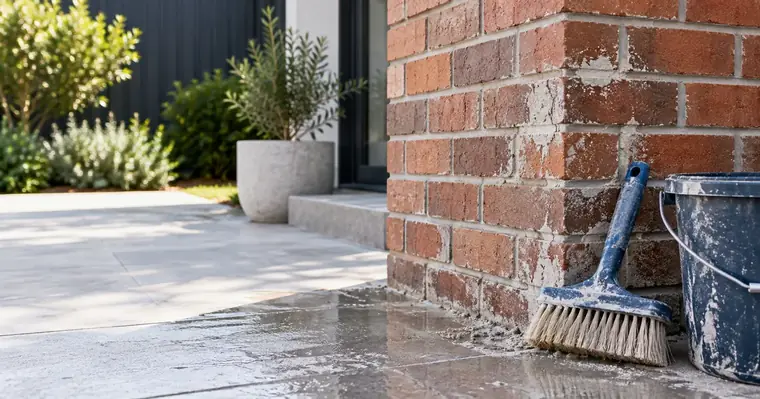
After the bricklayers
How is new brickwork cleaned after a build?
New brickwork is cleaned once the mortar has had about a week to harden. Large mortar dags are scraped off first, the wall is soaked with water, then a diluted brick cleaning solution is applied from the top down, left for a few minutes, scrubbed lightly and rinsed thoroughly before it can dry on the face.
Soaking the wall first is the step that protects it. A dry brick drinks the cleaning solution deep into its pores, where it can leave stains and draw salts out later. A saturated brick only lets the solution work on the surface, where the mortar residue sits. Manufacturers are specific about strength too: one brick maker's cleaning guide says never to go stronger than one part hydrochloric acid to ten parts water, and to start weaker.
Light-coloured and cream bricks need extra caution, since the wrong acid can leave green or brown staining that is harder to remove than the mortar. We check the brick type and follow the maker's instructions, using a proprietary brick cleaner rather than straight acid wherever that is recommended. This work is quoted separately after we have seen the wall.
Wall and house care
How are the mortar, windows and garden protected?
The mortar is protected by low pressure and a shallow angle, the house by keeping water out of weep holes, vents and window frames, and the garden by soaking plants before any product goes on. Acid-based cleaners are only used on new brickwork, and never where they can reach glass, aluminium or plants unprotected.
Brick veneer homes have a cavity behind the outer skin, with weep holes along the bottom course to let moisture out. Spraying straight into those holes pushes water into the cavity, which is exactly where it should not be. We rinse across them rather than into them. The same care applies to the damp-proof course line near the base of older walls and to wall vents under the floor.
Aluminium window frames, powder-coated gates and glass are covered or rinsed immediately if any cleaning solution reaches them, because acidic products etch these finishes. Plants along the wall are soaked first so their leaves and roots are full of clean water, then rinsed again at the end. Rinse water from an acid clean is neutralised before it goes anywhere.
Mortar that is already crumbling is worth a mention before we start. If a jet would dislodge it, the wall needs repointing before or instead of a clean, and we would rather tell you than make it worse.
Prices
How much does brick cleaning cost in Melbourne?
A typical brick fence or garden wall costs about $150 to $350 to clean, depending on length, height and how much moss there is. Larger walls are priced at roughly $4 to $8 per square metre. Cleaning new brickwork after a build is quoted separately because it is slower, chemical-based work.
| Job | Guide price | Notes |
|---|---|---|
| Brick fence, one side | $150 to $350 | 15 to 25 metres, up to about 1.8 metres high |
| Brick walls, larger areas | $4 to $8 per m² | Retaining and garden walls, single-storey house walls |
| Letterbox and gate piers | Added per pier | Usually done with the fence |
| Brick paths and paving | $4 to $6 per m² | Joint re-sanding extra if needed |
| New brickwork clean | Quoted per job | Depends on brick type, residue and access |
To compare against paving, decks or house washing, see our full list of pressure cleaning prices. Doing both sides of a fence in one visit costs noticeably less than two separate bookings, so it is worth checking with your neighbour first.
Wall photos
Which photos help price a brick clean?
A straight-on photo of the whole wall or fence, a close up of the mortar joints and one of the worst moss or stain patch give us what we need. Let us know the rough length and height, whether the brick is new or old, and if both sides of a fence are included.
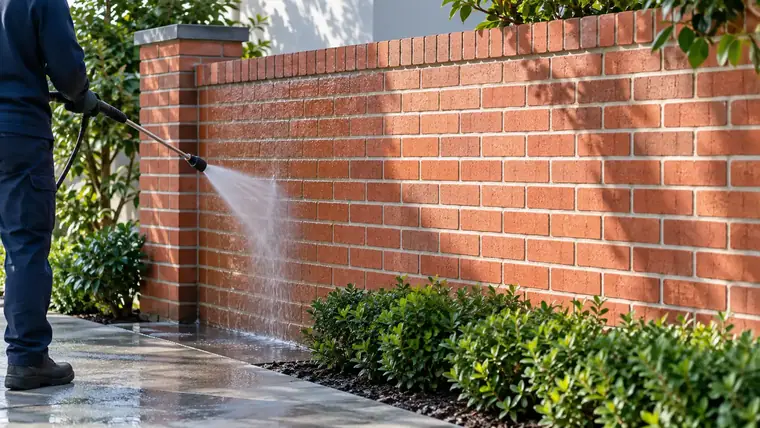
Straight on. The whole wall shows its size, height and any piers.
The joints. A close up tells us the mortar type and condition.
Old or new? New brickwork needs the brick type from the builder if you have it.
Brick questions
Which brick cleaning questions come up most?
How much does brick cleaning cost?
Can pressure washing damage brick and mortar?
How long does a brick fence take to clean?
Mossy fence or mortar-smeared new wall?Tell us about the wall, attach two photos, and the price comes back in writing.
Send photos