
Timber, composite and fences
Deck Cleaning
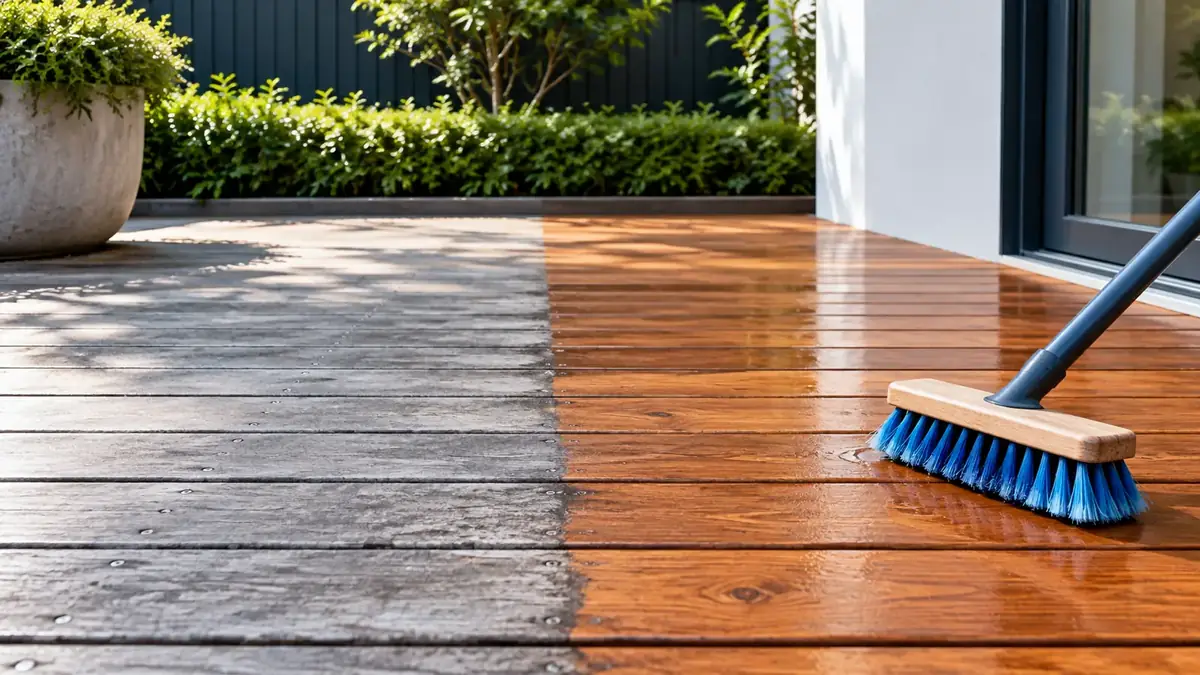
Deck cleaning for Melbourne homes, done with a deck cleaner and a low-pressure fan tip that follows the grain, so grey, mouldy timber comes back to its colour without the fuzzy, splintered surface a rushed job leaves. Composite boards are cleaned to their maker's limits, and timber fences can be done in the same visit. It is part of our pressure washing and soft washing across Melbourne, and the step before any oil or stain goes on.
- Deck
- 25 to 40 m²
- Boards
- Merbau or pine
- Pressure
- Low, fan tip
- Guide price
- $180 to $380
Timber or composite
What does deck cleaning in Melbourne involve?
Deck cleaning in Melbourne involves a deck cleaner to loosen grey fibres, mould and dirt, a short dwell time, then a low-pressure rinse along the boards with a wide fan tip. Timber is cleaned so it can take oil afterwards; composite is cleaned more gently still, following the manufacturer's care guide.
Timber decks
- Common boards
- Merbau, spotted gum, blackbutt, treated pine
- What builds up
- Grey weathering, mould, tannin bleed, flaking old oil
- Our approach
- Deck cleaner, then a 40 degree fan tip at low pressure along the grain
- Afterwards
- Dry for a couple of days, then oil or stain if wanted
Composite decks
- Common boards
- Capped and uncapped wood-plastic boards
- What builds up
- Mould in the texture, pollen, grease marks, water spots
- Our approach
- Mild cleaner and soft brush, then a gentle rinse within the maker's pressure limit
- Afterwards
- No oil needed; ready to use once dry
Most Melbourne timber decks are merbau, spotted gum or treated pine, and each weathers in its own way. Merbau bleeds dark tannin that stains nearby paving after rain. Spotted gum and blackbutt go silver-grey in full sun. Treated pine softens and splinters faster than hardwood when it is pushed too hard with water. A good clean restores the colour of all of them, but only up to the point where sun damage has broken down the fibres of the surface.
Coastal decks, from Frankston down through Mount Martha to Portsea, have a harder life than suburban ones. Salt air, strong sun off the water and sand trodden in from the beach all speed up greying, so Mornington Peninsula decks often need cleaning and recoating more often than those further inland.
Method and pressure
Why must a deck be washed at low pressure?
Timber is made of soft and hard growth rings side by side, and a strong jet cuts the soft rings away faster than the hard ones. That leaves a ridged, furry surface that feels rough underfoot and soaks up dirt. Low pressure with a wide fan tip lets the cleaner do the work instead.
Clean day2 to 4 hours
- Furniture and pots off the deck
- Plants below soaked and covered
- Deck cleaner applied and left to work
- Low-pressure rinse, board by board
Drying1 to 3 days
- Timber dries back to an even colour
- Light foot traffic is fine
- Raised fibres, if any, are sanded smooth
- Moisture checked before any coating
Oil or stainIf you want it
- Penetrating oil or stain applied evenly
- Left to cure before furniture returns
- Recoat plan set for the aspect and sun
- Covered in our deck staining service
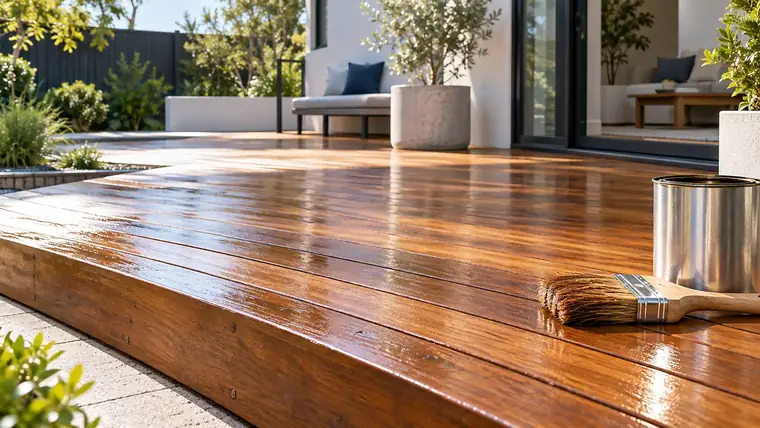
A clean on its own leaves timber looking fresh but bare, and bare timber greys again within a season in full sun. If you want the colour to last, oiling or staining is the next step, and it goes on best to wood that was cleaned properly a few days earlier. That work is covered on our deck cleaning and staining page.
What comes off
What can deck cleaning remove?
Deck cleaning removes grey weathered fibres, black mould and mildew, green algae, dirt, pollen, bird droppings, leaf stains and loose, flaking oil. It will not remove deep sun damage, cupped or split boards, or dark water stains around nail heads, which are part of the timber rather than something on it.
The silver-grey colour of an old deck is not dirt. It is the top layer of timber breaking down under UV light, leaving loose fibres behind. A deck cleaner loosens that layer and the rinse carries it away, which is why the colour underneath looks so different. On boards that have been bare for many years, the grey goes deeper, and a light sand after cleaning brings back a more even tone.
Old oil that has worn unevenly is another common problem. Patches that still have coating repel water while bare patches soak it up, so the deck looks blotchy. A cleaner with a stripping action evens this out before any new coat goes on. Black marks around screws and nails are iron reacting with tannin in the timber, and they need an oxalic-acid based brightener rather than more pressure.
Want to try a small deck yourself? Our guide on cleaning timber and composite decking covers products, tools and the pressure mistakes to avoid.
Fences, rails and steps
Can fences and handrails be cleaned at the same time?
Yes. Timber paling fences, pergolas, handrails, balustrades and deck steps are usually cleaned in the same visit as the deck, using the same low-pressure method. Doing them together costs less than separate bookings and means everything is ready to oil or paint at once.
Grey palings and green mould on the shaded side come up well. Old, thin palings are rinsed very gently.
Cleaned from the ground with extension wands, with mould treated on the underside of beams.
High-touch areas get extra attention, and slippery treads get a mould treatment.
Handrails and older decks carry one extra caution. Many decks and rails built before about 2006 used timber treated with copper chrome arsenate, known as CCA. An APVMA review of arsenic timber treatments led to CCA no longer being used for new domestic decking, handrails and outdoor furniture. Existing structures do not need to be removed, but they should not be blasted into splinters or sanded carelessly, and we keep wash water and debris from those decks out of vegetable gardens.
Colorbond and painted fences are a separate case. They are soft washed like a house wall, with a mild cleaner and gentle rinse, because high pressure can lift paint and scratch the coating.
Deck and garden care
How are the deck and the garden around it protected?
The deck is protected by keeping pressure low and the tip moving with the grain, and by using cleaners suited to the timber and any existing coating. The garden is protected by soaking plants before and after, covering anything delicate under or beside the deck, and rinsing cleaner off before it can dry.
What sits under a deck matters. Water and cleaner run between the boards onto whatever is below, whether that is a garden bed, a gravel base or a neighbour's side of the fence. We check underneath before starting and wet or cover it as needed. Screws and nails that have lifted are pointed out so they can be tapped down before anyone walks barefoot on a freshly cleaned deck.
Existing coatings are checked too. A deck with a film-forming varnish or paint behaves differently from one with a penetrating oil; strong strippers can lift a film coating in patches. If the coating is failing anyway, stripping it evenly is often the best outcome, and we talk it through before choosing a product.
How often a deck needs this depends mostly on sun and shade. A north-facing deck in full sun greys quickly but grows little mould, so a clean and recoat every one to two years keeps it looking cared for. A shaded deck under trees stays damp, collects leaves between the boards and grows slippery algae, so it benefits from a light clean each autumn even if the coating is still sound. Clearing leaves out of the gaps with a putty knife between cleans stops them rotting against the joists.
Prices
What does deck cleaning cost?
A typical 20 to 40 square metre timber deck costs about $180 to $380 to clean in Melbourne, depending on condition, steps and balustrades. Composite decks usually sit at the lower end. Timber fences are priced by the metre, roughly $6 to $12 per metre for one side.
| Job | Guide price | What moves it |
|---|---|---|
| Small deck or landing, under 20 m² | From about $180 | Minimum charge applies |
| Standard deck, 20 to 40 m² | $180 to $380 | Mould, old coating, number of steps |
| Large deck, over 40 m² | $5 to $9 per m² | Balustrades, multiple levels |
| Composite deck | $4 to $7 per m² | Texture, grease spots |
| Timber fence, one side | $6 to $12 per metre | Height, mould, access to the back |
These sit alongside the rates for driveways, paving and house washing on our full pressure cleaning price guide, which is handy if you are pricing a whole backyard at once.
Deck photos
Which deck photos give us an accurate price?
A photo of the whole deck from one corner, a close up of the boards at the worst spot, and one of any steps or balustrades give us enough to price it. Let us know the timber if you know it, and whether it has been oiled or stained before.
From a corner. The whole deck in one shot shows size, levels and rails.
Boards up close. Tells us the timber, the coating and how deep the grey goes.
Steps and rails. These add time, so include them if you want them done.
Fences too? One photo of each run with a rough length is plenty.
Questions
What do people ask about deck cleaning?
How much does deck cleaning cost?
Will pressure washing damage my deck?
How long until I can use the deck again?
Grey, slippery or blotchy deck?Send a few photos and get a written price for the clean.
Send photos